
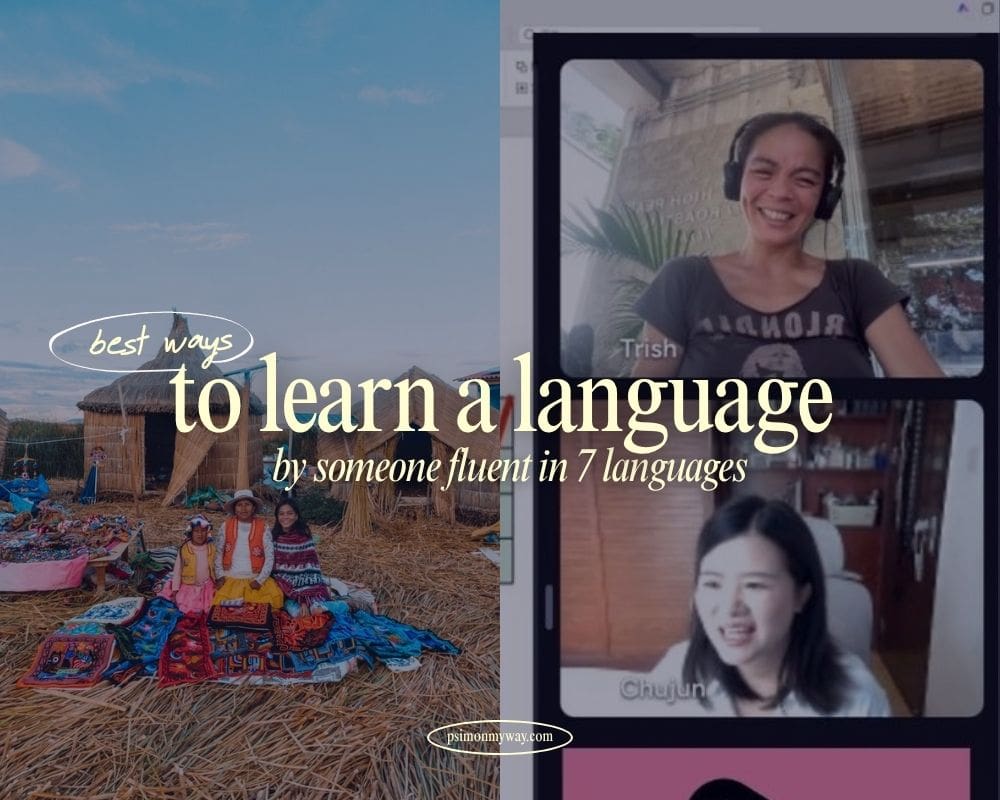
One of the best ways to learn a language quickly is to speak it from day one and don’t be ashamed. If you’re already traveling to another country, they don’t know you so might as well talk and make mistakes! Here are more realistic ways that you can use, from someone who speaks 7 languages.
Question from Mike R., Ohio
Hi Trisha! I'm from the US, and I just found out I'll be traveling to Buenos Aires, Argentina for work in a few months! I'm excited, but also a little nervous because I only know a few words of Spanish from high school. I'm amazed that you speak about seven languages, so I have to ask: how would you learn a language quickly when you have a deadline like this? Should I use an app, find a tutor, or just try to pick it up once I get there? I'd love to at least be able to handle meetings and order food without panicking!
Hola Mike!
I love Buenos Aires. I actually spoke Argentine Spanish first, then I realized not everyone can understand me so I changed my accent and vocabulary through the years.
I have to be honest with you though: learning a language is only easy if you are willing. I find that my willingness to learn took me a long way that’s why I can speak several languages.
The best ways to learn a language quickly are to speak from day one. Many people I know are shy and afraid but what are you afraid of if you don’t know these people?
Remember, you are traveling to another country being surrounded by people who don’t know you. That’s the best time to just DO IT and not give a fuck.
Three months is plenty of time to get there, and a deadline helps because it gives you a clear reason to practice. I’ve learned about seven languages this way, and here are the steps I’d follow in your situation.

Music is one of the best ways to learn a language, and I know because it’s exactly how I learned Spanish and Portuguese.
It started with playlists. I’m a huge music lover, so I built playlists full of songs I could jive to and played them everywhere: in the kitchen, on walks, on the bus, even while doing chores. I never picked songs because they were “educational.” If the tune made me want to dance, it made the cut.
Here’s the funny part: I didn’t care if I understood the lyrics. As long as I could sing along, I was happy. I belted out words I couldn’t translate, and somehow they started sticking anyway.
Then one day, after I’d become fluent, something clicked. I was listening to a song I’d sung a hundred times, and suddenly I understood every word. I didn’t have to think about it.
Because I already knew the lyrics by heart, I could just feel the song, the meaning and the music landing together. It was amazing!!!
That’s why I tell anyone looking for the best ways to learn a language to start with what they love. When you enjoy the process, you keep showing up, and that makes all the difference.

Street Mandarin doesn’t fly in a boardroom. I learned that the hard way.
For years, I picked up languages the way I like best: out on the streets, talking to anyone who’d talk back. It worked. I can chat, joke, and haggle fluently. But ask me why a sentence is correct, and I’d just shrug.
So I hired a tutor on Preply, and honestly, it’s one of the best ways to learn a language online. In fact, there was a study done and 9 times as many language learners said Preply was more motivating than a self-learning language app.
A few things sold me:
One thing, though: Preply is paid because you’re working one-on-one with a real tutor, so treat it that way. Sign up when you’re serious and have the time, not just for the sake of it.

For nineteen years I have been traveling the world, and in that time I’ve become fluent in seven languages without ever sitting through a single language class.
My classroom has been the world. Somewhere along the way I figured out that worldschooling is another one of the best ways to learn a language, because when you live in a place, the language stops being a subject and becomes a necessity.
When I order dinner, I do it in the local language, and when I join a pilates or yoga class taught in that language, I quickly pick up phrases like “breathe in” and “other leg” whether I want to or not. I also join local sports clubs, where nobody cares that I’m the newcomer, only that I understand the game plan.
The secret ingredient is time. I usually stay about three months in one city. That’s long enough for the barista to know my order, for neighbors to start chatting, and for the words to finally stick.
And I always pick activities where English isn’t an option: cooking classes, walking tours, anything I’d enjoy anyway. Nobody stays confused when there’s good food involved.
That’s how seven languages happened: not through textbooks, just through living.
?? You might also like: How I find host families abroad

Fifteen minutes a day doesn’t sound like much, but it’s one of the best ways to learn a language, and it’s the habit that finally made things stick for me.
I used to think I needed hours of study to make progress. Spoiler: I never had hours, so I did nothing.
Then I tried something small. I opened a language app every morning with my coffee, set a timer for 15 minutes, and that was it. Fifteen minutes is better than nothing, and it adds up faster than you’d think.
Mornings turned out to be a smart choice. Research suggests that many people are at their mental sharpest in the hours after waking, when focus and alertness tend to peak, which makes it a great time to learn something new.
So my coffee became the cue. Now the smell of it practically says, “Time to study.” If you’re a night owl, then do it at night before you sleep or while you’re sipping your evening tea.
I won’t lie, the first three weeks took discipline and a lot of enforcement. I made myself show up even on days I didn’t feel like it. But around week four, it became easier. My brain started signaling that this was the time, and I did it without thinking.
So my advice: don’t force a random schedule. Find the moment in your day that works for you, pick the same time or activity, and stick with it.

My 5th grade English teacher gave us a simple assignment that ended up shaping how I learn every language: keep a word bank. It’s still one of the best ways to learn a language I know.
The rules were easy. Every day, I picked one new word, looked it up in the dictionary, and then used it in a real sentence that same day. Not a made-up textbook sentence, but one I actually said out loud, especially when I am alone.
I figured I’d drop the habit once the assignment ended. I never did. One word a day doesn’t feel like work, but it quietly stacks up. After a year, that’s 365 new words. After all these years, I’ve lost count, and that’s the best part.
Using the word right away is what makes it stick. A word I’ve only read fades fast, but a word I’ve said to someone is mine.
Here’s what surprised me: I never needed to re-read my words or review them. They just stuck, day by day. Since it’s only one word, it never felt overwhelming, and using it right away did the rest. A word I’ve only read fades fast, but for me, writing it down is what makes it stick.
Now I’m passing it on to my 3-year-old son. We pick a word together, figure out what it means, and use it during the day. Watching him proudly drop a new word into conversation might be my favorite part of the whole thing!!!
If you love notebooks, treat yourself to a really nice one and make it your word bank. Design a cover with “Word Bank” on it. When your notebook looks that good, you’ll actually want to open it every day!

“Isn’t that dangerous?” Everyone asked me that, and I get it. Moving in with a stranger’s family in another country, where nobody speaks English, sounds a little wild.
But staying in a local home turned out to be one of the best ways to learn a language I’ve ever tried.
I stayed with Brazilian, Uruguayan, and Colombian families, which I found through volunteering websites and traveler groups. Every stay lasted at least 30 days, long enough to stop feeling like a guest and start feeling like part of the family.
With no English to fall back on, my brain was forced to keep up. And I’m not someone who sits quietly while everyone laughs at the dinner table. I refuse to be left out! So I jumped into every conversation, mangled sentences and all, until I got my point across.
Nobody judged me when I got it wrong, either. They didn’t speak English, so all they could do was help me find the right words, and that made it easy to keep trying.
Those dinners taught me more than any classroom could. Slang, jokes, the way people really talk, all served with a plate of home-cooked food.
It’s the one thing that made me truly fluent in communicating, and if you’re brave enough, it’s the one I’d recommend most!

My husband still brings up the day I labeled the entire kitchen in Spanish. “Nevera” on the fridge, “sal” on the salt, sticky notes on every condiment. He freaked out. I kept going.
Making your home a language environment is one of the best ways to learn a language, even when you’re not traveling.
My son soaked it up, and guess what? After a while, my husband became fluent in Spanish just from walking past those labels every day. No classes, nothing.
It’s also good for our brains as we age to know the kitchen stuff and condiments in another language.
I also keep songs playing at home all the time, so the language is always going in the background, whether I’m cooking or folding laundry.
Then I changed my phone and computer settings to that language. It felt weird at first, but it made me learn the words I actually use every day. And it cut down my screen time, because scrolling is a lot less fun when you have to figure out every button.
Now the language isn’t something I have to go find. It’s just part of my house.
Here’s a bonus I didn’t see coming: learning Spanish is one of the best ways to learn a language that actually changes your life, and for me it changed my paperwork too.
I lived in Mexico for 7 years. My son was born there, and somewhere along the way, Mexico stopped feeling like a place I was visiting and started feeling like home. So I decided to become a Mexican citizen.
Here’s the thing: the citizenship exam is in Spanish. Because I was already fluent, I passed it easily. I didn’t have to stress or cram. I just showed up and did it.
I think about that a lot. All those dinners, songs, and sticky notes weren’t just helping me chat with neighbors. They opened a door I didn’t even know I’d want to walk through.
Now I’m a Mexican citizen, and I owe it to the language.
 PHPTRAVELS v8